
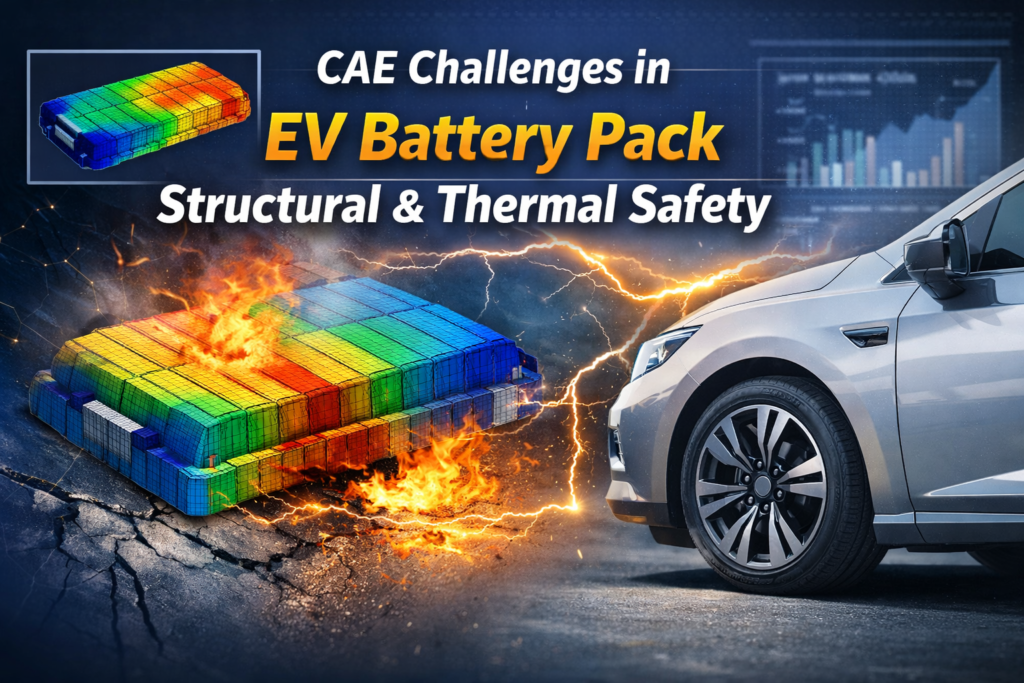
The rise of electric vehicles (EVs) is transforming the automotive industry. At the center of this transformation lies the EV battery pack, one of the most critical and complex components of an electric vehicle. While battery technology enables clean mobility, it also introduces major engineering challenges related to structural integrity, thermal safety, and system reliability.
Ensuring the safety of EV battery packs is not easy. Engineers must ensure that batteries remain stable during crashes, high temperatures, fast charging, and extreme operating conditions. This is where Computer-Aided Engineering (CAE) simulation plays a vital role.
CAE allows engineers to test battery designs virtually, identify potential risks early, and optimize battery structures before physical prototypes are built. However, simulating EV battery safety brings its own set of challenges.
The Role of CAE in EV Battery Design
Modern EV development heavily depends on advanced CAE simulation tools. These tools help engineers understand how battery packs behave under different conditions such as mechanical impact, heat generation, and electrical load.
Using CAE, engineers can:
- Simulate vehicle crash scenarios
- Analyze battery pack deformation
- Predict heat generation and thermal propagation
- Design efficient battery cooling systems
- Evaluate risks like thermal runaway
Because EV batteries contain highly reactive lithium-ion cells, safety analysis is extremely important. A small failure inside a battery cell can trigger a chain reaction that spreads heat and damage throughout the entire pack.
Through multiphysics simulations, CAE helps engineers detect these risks early and improve battery pack safety.
Structural Safety Challenges in EV Battery Packs
Crash Protection
In most electric vehicles, the battery pack is installed in the vehicle floor. This location improves stability but also exposes the battery pack to potential damage during collisions.
During crash events such as frontal impacts, side collisions, or underbody strikes, the battery enclosure must protect the cells from excessive deformation. Even minor structural damage can lead to internal short circuits, which may cause overheating or fire.
CAE crash simulations help engineers analyze how the battery pack structure responds during impact. By optimizing enclosure design and materials, engineers can improve crashworthiness while keeping the battery lightweight.
Cell Deformation and Mechanical Damage
Battery cells are sensitive to mechanical abuse. When cells are crushed or deformed, the internal separator layers may fail. This can allow electrodes to touch each other, creating internal short circuits.
Such failures generate heat rapidly and can initiate thermal runaway, a dangerous condition where the battery temperature increases uncontrollably.
CAE tools allow engineers to simulate cell deformation, module behavior, and pack-level structural responses, helping identify potential failure points before real-world testing.
Thermal Safety Challenges in EV Batteries
Thermal Runaway Risk
One of the biggest safety concerns in EV batteries is thermal runaway propagation. This occurs when a single battery cell overheats and transfers heat to neighboring cells.
If not controlled, the heat spreads across the battery module, potentially causing fires or explosions. Preventing this chain reaction is a major focus of EV battery design.
CAE simulations allow engineers to study how heat spreads between cells and evaluate whether the battery design can contain thermal events.
Battery Cooling and Thermal Management
EV batteries generate significant heat during:
- Fast charging
- High acceleration
- Hot environmental conditions
Without proper cooling, battery temperatures can rise beyond safe limits. High temperatures reduce battery life and increase safety risks.
CAE helps engineers design effective thermal management systems, including liquid cooling plates, airflow channels, and thermal interface materials. By simulating heat transfer, engineers can ensure uniform temperature distribution across the battery pack.
The Complexity of EV Battery Simulation
EV battery safety involves multiple physical processes happening simultaneously. Engineers must analyze mechanical, thermal, electrical, and electrochemical interactions within the battery system.
This makes EV battery simulation one of the most challenging applications of CAE in automotive engineering. Advanced simulation tools are required to accurately model these complex behaviors.
Despite these challenges, CAE significantly reduces development time and cost by enabling engineers to test multiple design concepts virtually.
Conclusion
As electric vehicles continue to grow in popularity, ensuring EV battery pack safety becomes increasingly important. Battery systems must withstand crashes, manage heat effectively, and prevent dangerous failures like thermal runaway.
Advanced CAE simulation allows engineers to analyze structural strength, predict thermal behavior, and optimize battery pack designs early in the development process.
By using CAE-driven engineering, automotive companies can build safer, more reliable, and more efficient EV battery systems, supporting the future of electric mobility.