
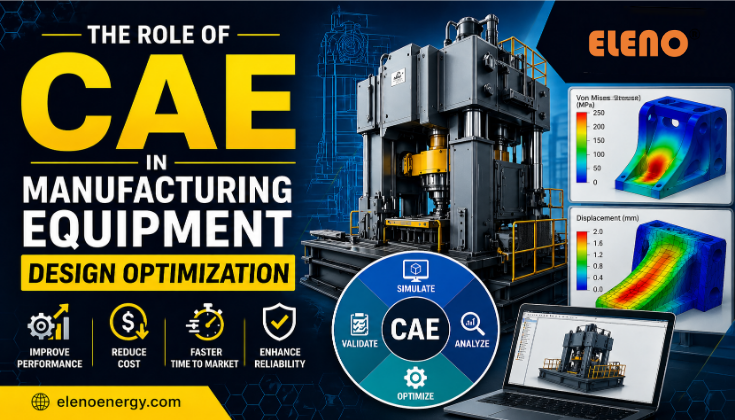
In today’s highly competitive industrial landscape, manufacturing companies are under constant pressure to design equipment that is efficient, cost-effective, and high-performing. This is where Computer-Aided Engineering (CAE) plays a transformative role.
At Eleno Energy, we emphasize how CAE-driven design is not just a tool—but a strategic advantage for modern engineers working on manufacturing equipment.
What is CAE in Manufacturing?
Computer-Aided Engineering (CAE) refers to the use of advanced simulation tools to analyze, validate, and optimize engineering designs digitally before physical production.
Instead of relying on trial-and-error methods, engineers can simulate real-world conditions such as:
- Stress and deformation
- Thermal behavior
- Fluid flow
- Vibrations and fatigue
This enables smarter and faster design decisions early in the development cycle.
Why CAE is Critical for Manufacturing Equipment Design
Manufacturing equipment—like presses, molds, conveyors, and automation systems—must operate with precision, durability, and efficiency. CAE ensures this by allowing engineers to:
1. Optimize Design Before Production
CAE acts as a virtual testing environment, helping engineers predict performance and identify design flaws before manufacturing begins.
This reduces costly design errors and rework.
2. Reduce Prototyping Costs
Traditional design requires multiple physical prototypes. With CAE:
- Hundreds of design iterations can be tested virtually
- Physical prototyping is minimized
This significantly lowers development costs and speeds up time-to-market.
3. Improve Equipment Performance & Reliability
CAE tools help analyze:
- Structural strength (FEA)
- Heat transfer (thermal analysis)
- Fluid behavior (CFD)
By simulating these factors, engineers can enhance durability and operational efficiency of machine
4. Enhance Manufacturing Process Efficiency
CAE is not limited to product design—it also optimizes manufacturing processes such as:
- Casting and molding
- Welding and forming
- Assembly and automation
For example, simulation can predict defects like shrinkage or porosity and help eliminate them in advance.
5. Enable Design Optimization & Innovation
With advanced algorithms and simulation loops, CAE enables:
- Parameter optimization
- Lightweight design
- Material reduction
This results in better-performing and cost-efficient equipment designs.
Key CAE Techniques Used in Equipment Design
Finite Element Analysis (FEA)
Used to analyze stress, deformation, and structural integrity.
Computational Fluid Dynamics (CFD)
Helps optimize cooling systems, airflow, and fluid movement.
Multibody Dynamics (MBD)
Simulates motion, forces, and kinematics of moving parts.
Thermal Analysis
Ensures proper heat dissipation in high-temperature equipment.
Real-World Application Example
In manufacturing industries like automotive and die-casting:
- CAE is used to optimize gate and runner systems
- Helps reduce defects like air entrapment and shrinkage
- Improves final product quality significantly
This directly impacts production efficiency and reduces waste.
Benefits of CAE in Manufacturing Equipment Design
✔ Faster product development
✔ Reduced costs and material usage
✔ Improved product quality
✔ Enhanced safety and reliability
✔ Better decision-making through simulation insights
Future of CAE in Manufacturing
With the integration of:
- AI-driven optimization
- Digital twins
- Cloud simulation
CAE is evolving into a core pillar of smart manufacturing and Industry 4.0.
Companies that adopt CAE early will gain a competitive edge in innovation and efficiency.
Conclusion
The role of CAE in manufacturing equipment design optimization is no longer optional—it is essential. By enabling virtual testing, reducing costs, and improving performance, CAE empowers engineers to build smarter, faster, and more reliable systems.
At Eleno Energy, we help engineers and organizations master these advanced simulation techniques to stay ahead in the evolving engineering landscape.