
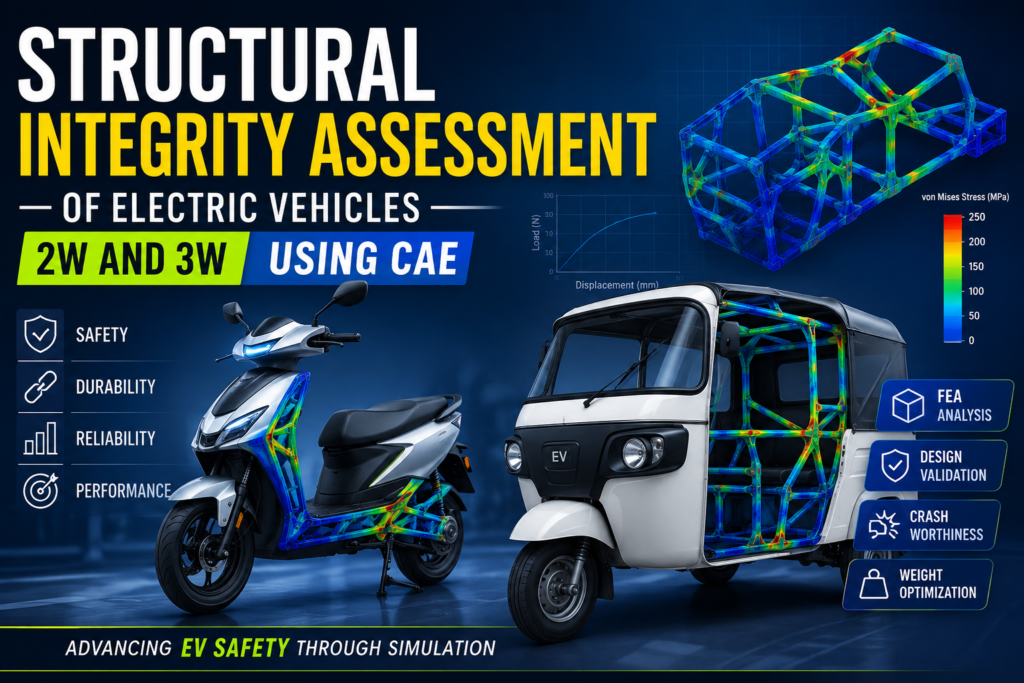
The rapid growth of electric mobility is transforming transportation across India and the world. Electric Two-Wheelers (E2W) and Electric Three-Wheelers (E3W) have become the backbone of sustainable urban transportation due to their affordability, low operating costs, and environmental benefits. However, ensuring the structural integrity, safety, durability, and crashworthiness of these vehicles remains a critical engineering challenge.
This is where Computer-Aided Engineering (CAE) plays a vital role. By leveraging advanced simulation technologies such as Finite Element Analysis (FEA), LS-DYNA Crash Analysis, Structural Analysis, Modal Analysis, and Durability Simulation, engineers can evaluate vehicle performance before physical prototypes are built, reducing development costs and improving product safety.
At ELENO Energy, CAE-driven engineering solutions help manufacturers design robust and reliable electric vehicles that meet modern safety and performance requirements.
Why Structural Integrity Matters in Electric 2W and 3W Vehicles
Unlike conventional vehicles, electric vehicles integrate heavy battery packs, electric motors, controllers, and power electronics into lightweight structures. These additional components significantly affect load distribution and vehicle dynamics.
Poor structural design can lead to:
- Battery enclosure failure
- Excessive frame deformation
- Reduced vehicle durability
- Increased vibration and noise
- Safety risks during collisions
- Thermal runaway risks due to battery damage
Therefore, manufacturers must validate the structural performance of electric vehicles under various operating and crash conditions. CAE simulations enable engineers to identify weaknesses early in the design phase and optimize the structure for safety and performance.
Role of CAE in Electric Vehicle Structural Assessment
1. Static Structural Analysis
Static analysis evaluates the vehicle frame, chassis, battery enclosure, and mounting brackets under different loading conditions.
Engineers simulate:
- Rider and passenger loads
- Cargo loads
- Battery pack weight
- Cornering forces
- Braking forces
- Road impact loads
The objective is to ensure stresses remain below material yield limits while maintaining acceptable deformation levels.
Benefits:
- Improved frame strength
- Reduced structural failures
- Lightweight design optimization
- Enhanced vehicle reliability
Static Structural Analysis, EV Chassis Design, Battery Pack Structural Analysis, Electric Vehicle Frame Simulation
2. Modal Analysis for Vibration Assessment
Electric vehicles experience continuous vibration from road irregularities, motors, and drivetrain components.
Modal analysis helps identify:
- Natural frequencies
- Mode shapes
- Resonance conditions
- Dynamic behavior of battery enclosures
Studies show that proper modal analysis is essential for preventing resonance-related failures and ensuring long-term durability of EV battery systems.
Modal Analysis, EV Vibration Analysis, Battery Enclosure Vibration Simulation, CAE for Electric Vehicles
3. Crashworthiness Analysis Using LS-DYNA
Crash safety is one of the most critical aspects of electric vehicle design.
Using LS-DYNA Crash Simulation, engineers evaluate:
- Frontal impact
- Side impact
- Rear impact
- Pole impact
- Underbody impact
The goal is to minimize structural intrusion and protect critical components such as the battery pack.
Crashworthiness simulations help manufacturers improve occupant safety and reduce the risk of battery damage during collisions.
LS-DYNA Crash Analysis, EV Crashworthiness, Electric Vehicle Safety Simulation, Impact Analysis
4. Battery Pack Structural Integrity Assessment
The battery pack is the most expensive and safety-critical component of an electric vehicle.
CAE simulations assess:
- Battery enclosure strength
- Mechanical abuse resistance
- Crush performance
- Drop test simulation
- Thermal-structural interaction
Research demonstrates that optimized battery enclosure designs significantly improve safety against impact and vibration loads while maintaining lightweight characteristics.
Keywords: Battery Pack Analysis, Battery Enclosure Design, EV Battery Safety, Battery Crash Simulation
5. Durability and Fatigue Analysis
Electric 2W and 3W vehicles operate under highly variable road conditions.
Repeated loading can cause:
- Fatigue cracks
- Weld failures
- Bracket deformation
- Structural degradation
Durability analysis predicts vehicle life by simulating millions of loading cycles under real-world conditions.
Benefits include:
- Longer vehicle lifespan
- Reduced warranty claims
- Improved reliability
- Better customer satisfaction
Fatigue Analysis, Durability Simulation, Electric Vehicle Reliability, Vehicle Life Prediction
Key Components Evaluated During Structural Integrity Assessment
Electric Two-Wheeler Components
- Main frame
- Swing arm
- Battery enclosure
- Motor mounting brackets
- Suspension mounting points
- Footboard structure
Electric Three-Wheeler Components
- Chassis frame
- Cabin structure
- Cargo frame
- Battery housing
- Suspension brackets
- Roof support structure
Each component undergoes detailed CAE validation to ensure compliance with performance and safety requirements.
CAE Tools Used for EV Structural Assessment
Modern EV development relies on advanced CAE software such as:
- LS-DYNA
- ANSYS Mechanical
- HyperMesh
- OptiStruct
- Abaqus
- LSPP
- ANSA
These tools help engineers perform:
- Finite Element Analysis (FEA)
- Explicit Dynamics
- Crash Simulation
- Modal Analysis
- Fatigue Analysis
- Optimization Studies
Benefits of CAE for Electric Vehicle Manufacturers
Faster Product Development
Virtual simulations reduce dependency on physical prototypes.
Cost Reduction
Design issues are identified early, minimizing expensive redesigns.
Improved Safety
Crash simulations enhance vehicle and battery protection.
Lightweight Design
Optimization helps reduce vehicle weight while maintaining strength.
Regulatory Compliance
CAE supports validation against industry safety standards and testing requirements.
Future of Structural Simulation in Electric Mobility
As electric mobility continues to evolve, CAE will become even more important. Emerging technologies such as:
- Digital Twins
- AI-Driven Simulation
- Multi-Physics Analysis
- Advanced Battery Modeling
- Autonomous Vehicle Safety Simulation
will further improve the efficiency and accuracy of electric vehicle development.
Manufacturers that adopt CAE-driven engineering approaches will gain a significant advantage in delivering safer, lighter, and more reliable electric vehicles to the market.
Conclusion
The success of Electric Two-Wheelers and Three-Wheelers depends not only on battery technology but also on the structural integrity of the vehicle. Through advanced CAE simulation, FEA, LS-DYNA crash analysis, modal analysis, and durability assessment, engineers can design vehicles that meet the highest standards of safety, reliability, and performance.
At ELENO Energy, we leverage advanced CAE methodologies to support the next generation of electric mobility solutions, helping manufacturers accelerate innovation while ensuring structural excellence.