ELENO Energy

Nachiket Phadke

Founder – ELENO 20+ years of experience in CAE, LS-DYNA, vehicle crash & safety simulations, OEM & Tier-1 projects.

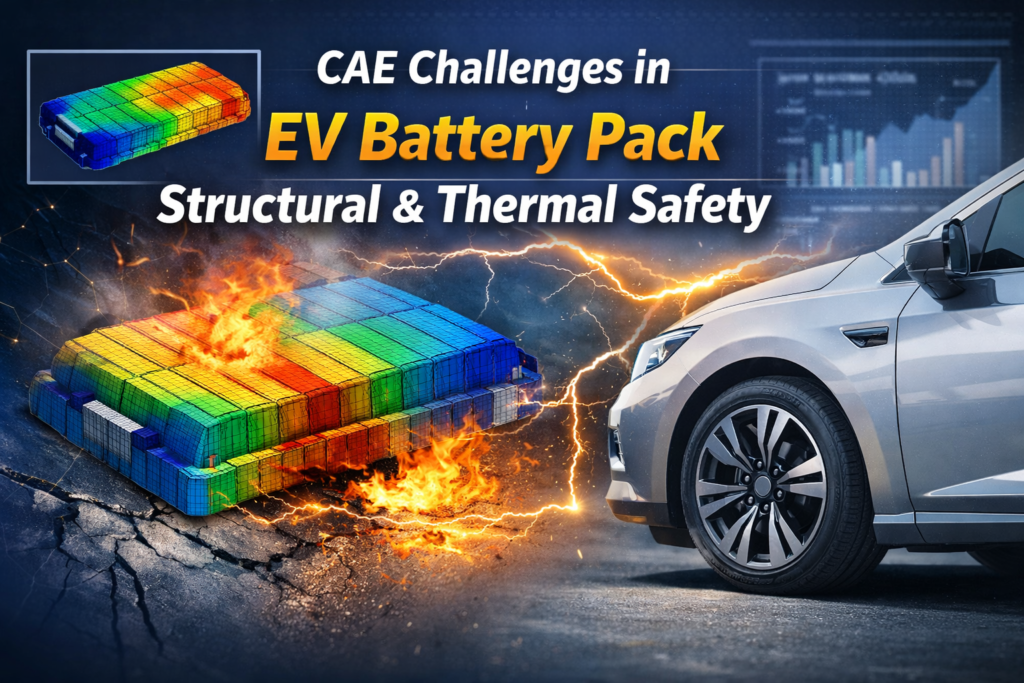
EV battery pack CAE simulation for structural crash and thermal safety analysis

CAE Challenges in EV Battery Pack Structural & Thermal Safety

The rise of electric vehicles (EVs) is transforming the automotive industry. At the center of this transformation lies the EV battery pack, one of the most critical and complex components of an electric vehicle. While battery technology enables clean mobility, it also introduces major engineering challenges related to structural integrity, thermal safety, and system reliability. Ensuring the safety of EV battery packs is not easy. Engineers must ensure that batteries remain stable during crashes, high temperatures, fast charging, and extreme operating conditions. This is where Computer-Aided Engineering (CAE) simulation plays a vital role. CAE allows engineers to test battery designs virtually, identify potential risks early, and optimize battery structures before physical prototypes are built. However, simulating EV battery safety brings its own set of challenges. The Role of CAE in EV Battery Design Modern EV development heavily depends on advanced CAE simulation tools. These tools help engineers understand how battery packs behave under different conditions such as mechanical impact, heat generation, and electrical load. Using CAE, engineers can: Because EV batteries contain highly reactive lithium-ion cells, safety analysis is extremely important. A small failure inside a battery cell can trigger a chain reaction that spreads heat and damage throughout the entire pack. Through multiphysics simulations, CAE helps engineers detect these risks early and improve battery pack safety. Structural Safety Challenges in EV Battery Packs Crash Protection In most electric vehicles, the battery pack is installed in the vehicle floor. This location improves stability but also exposes the battery pack to potential damage during collisions. During crash events such as frontal impacts, side collisions, or underbody strikes, the battery enclosure must protect the cells from excessive deformation. Even minor structural damage can lead to internal short circuits, which may cause overheating or fire. CAE crash simulations help engineers analyze how the battery pack structure responds during impact. By optimizing enclosure design and materials, engineers can improve crashworthiness while keeping the battery lightweight. Cell Deformation and Mechanical Damage Battery cells are sensitive to mechanical abuse. When cells are crushed or deformed, the internal separator layers may fail. This can allow electrodes to touch each other, creating internal short circuits. Such failures generate heat rapidly and can initiate thermal runaway, a dangerous condition where the battery temperature increases uncontrollably. CAE tools allow engineers to simulate cell deformation, module behavior, and pack-level structural responses, helping identify potential failure points before real-world testing. Thermal Safety Challenges in EV Batteries Thermal Runaway Risk One of the biggest safety concerns in EV batteries is thermal runaway propagation. This occurs when a single battery cell overheats and transfers heat to neighboring cells. If not controlled, the heat spreads across the battery module, potentially causing fires or explosions. Preventing this chain reaction is a major focus of EV battery design. CAE simulations allow engineers to study how heat spreads between cells and evaluate whether the battery design can contain thermal events. Battery Cooling and Thermal Management EV batteries generate significant heat during: Without proper cooling, battery temperatures can rise beyond safe limits. High temperatures reduce battery life and increase safety risks. CAE helps engineers design effective thermal management systems, including liquid cooling plates, airflow channels, and thermal interface materials. By simulating heat transfer, engineers can ensure uniform temperature distribution across the battery pack. The Complexity of EV Battery Simulation EV battery safety involves multiple physical processes happening simultaneously. Engineers must analyze mechanical, thermal, electrical, and electrochemical interactions within the battery system. This makes EV battery simulation one of the most challenging applications of CAE in automotive engineering. Advanced simulation tools are required to accurately model these complex behaviors. Despite these challenges, CAE significantly reduces development time and cost by enabling engineers to test multiple design concepts virtually. Conclusion As electric vehicles continue to grow in popularity, ensuring EV battery pack safety becomes increasingly important. Battery systems must withstand crashes, manage heat effectively, and prevent dangerous failures like thermal runaway. Advanced CAE simulation allows engineers to analyze structural strength, predict thermal behavior, and optimize battery pack designs early in the development process. By using CAE-driven engineering, automotive companies can build safer, more reliable, and more efficient EV battery systems, supporting the future of electric mobility.

CAE Challenges in EV Battery Pack Structural & Thermal Safety Read More »
Automotive seating systems_seating systemsSimulation_CAE

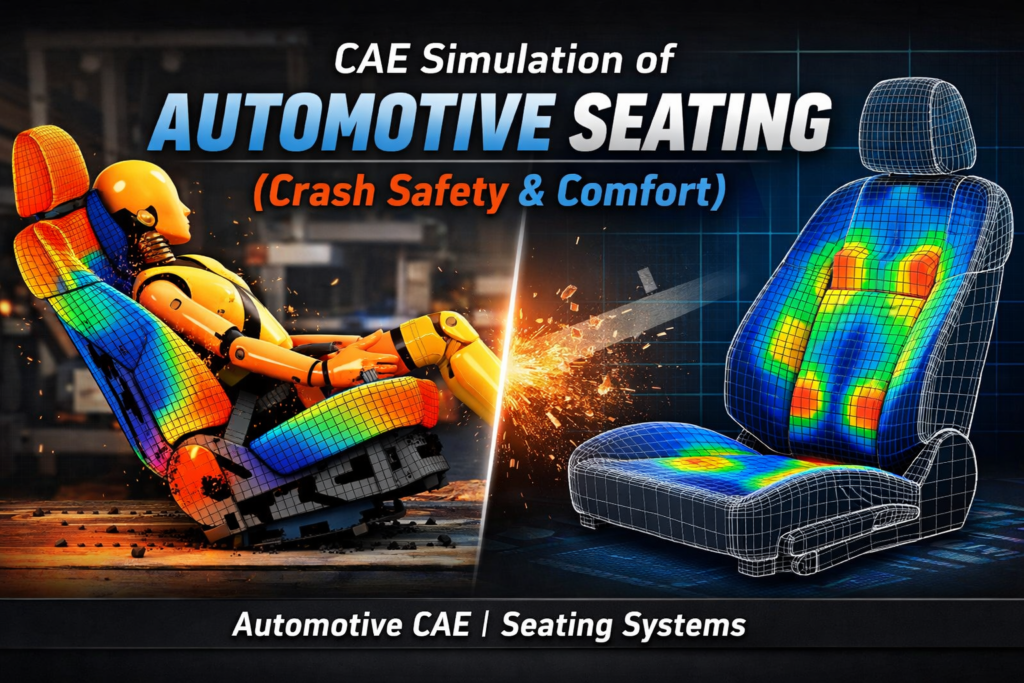
CAE Simulation of Automotive Passenger & Commercial Seating Systems for Crash & Comfort

Automotive seating systems are critical safety and comfort components, not just interior parts. During a crash, seats must manage occupant loads, maintain restraint geometry, and prevent severe injuries. At the same time, they must deliver long-term comfort—especially in commercial vehicles. This is why CAE simulation of seating systems has become essential in modern vehicle development. At ELENO Energy, we train engineers to understand real-world seating system simulation workflows used by OEMs and Tier-1 suppliers. Why CAE Is Used for Seating System Design CAE helps engineers: Crash simulations are typically performed using LS-DYNA, while comfort and durability require detailed material and contact modeling. Passenger vs Commercial Seating: CAE Focus Commercial seating systems demand advanced CAE validation due to continuous usage and extreme operating conditions. Tools & Skills Used in Seating CAE Engineers working on seating systems commonly use: Strong fundamentals in mechanics and crash physics are essential. Career Scope in Seating System CA Seating CAE engineers are hired by: This domain offers stable, high-value CAE career opportunities across safety and comfort engineering roles. ELENO Energy Approach ELENO Energy focuses on: Our programs help engineers become job-ready CAE professionals, not just software users. Final Note As safety regulations and vehicle architectures evolve, CAE simulation of seating systems for crash and comfort remains a critical skill for modern automotive engineers.

CAE Simulation of Automotive Passenger & Commercial Seating Systems for Crash & Comfort Read More »

mix-simulatio-eleno

Role of CAE in Full Vehicle Development: From Concept to Homologation

Role of CAE in Full Vehicle Development: From Concept to Homologation In modern automotive engineering, Computer-Aided Engineering (CAE) plays a key role in developing a vehicle from the first idea to final approval (homologation). CAE helps engineers test, analyze, and improve a vehicle virtually, saving both time and cost. At ELENO Energy, CAE is used to support smarter, faster, and safer vehicle development using simulation-driven engineering. What is CAE in Vehicle Development? CAE is the use of simulation tools to understand how a vehicle will behave in real-world conditions.Instead of building many physical prototypes, engineers use CAE to test: This makes CAE a core part of full vehicle development. 1. Concept Stage: Turning Ideas into Virtual Models In the early concept stage, CAE helps engineers test whether a vehicle design will work or not. How CAE helps: This stage helps companies avoid costly mistakes later in development. 2. Design & Engineering Stage: Improving Performance Once the concept is finalized, CAE is used to improve and refine the vehicle design. Structural & Crash Analysis CAE simulations predict how the vehicle structure behaves during crashes. This helps improve: Thermal & NVH Analysis Aerodynamics CAE helps reduce air resistance, which improves: At this stage, CAE supports better design decisions without repeated physical testing. 3. Validation & Homologation: Meeting Regulations Before a vehicle can be sold, it must meet safety and legal standards. This process is called homologation. CAE supports this phase by: This saves both time and development cost while ensuring compliance with regulations. 4. Why CAE is Critical for Full Vehicle Development Using CAE across the full vehicle lifecycle offers many benefits: ✔ Faster development✔ Lower prototyping cost✔ Improved safety✔ Better product quality✔ Fewer design changes at later stages This is why CAE is now essential for OEMs, Tier-1 suppliers, and EV manufacturers. Conclusion The role of CAE in full vehicle development is crucial — from early concept design to final homologation. It enables engineers to predict performance, improve safety, and launch vehicles faster. At ELENO Energy, CAE-driven engineering helps build reliable, efficient, and compliant vehicles using advanced simulation techniques.

Role of CAE in Full Vehicle Development: From Concept to Homologation Read More »

cae-simulation-eleno

Pioneering Engineering Solutions: Exploring ELENO’s CAE Innovations

Introduction:In the realm of modern engineering, innovation is the cornerstone of progress. ELENO, a trailblazer in the field, revolutionizes traditional approaches with its cutting-edge Computer-Aided Engineering (CAE) solutions. Join us as we embark on a journey to uncover the transformative impact of ELENO’s CAE expertise across diverse industries. Body: ELENO’s CAE services redefine automotive engineering, empowering manufacturers to achieve unprecedented levels of safety and performance.Through advanced simulations, ELENO optimizes vehicle designs, ensuring superior crashworthiness and enhancing overall durability.With ELENO’s CAE solutions, automotive innovators streamline product development, reduce costs, and accelerate time-to-market, driving the industry towards a brighter future. In the defense sector, precision and reliability are paramount, and ELENO’s CAE services rise to the challenge.By simulating complex scenarios and conducting rigorous analyses, ELENO fortifies defense systems with unmatched resilience and effectiveness.ELENO’s CAE expertise empowers defense engineers to anticipate threats, optimize performance, and uphold the highest standards of security and protection. The era of electric mobility is upon us, and ELENO leads the charge with its innovative CAE solutions for electric vehicles (EVs).Leveraging state-of-the-art techniques, ELENO enhances battery performance, extends range, and optimizes vehicle dynamics for EV manufacturers.With ELENO’s CAE services, the promise of sustainable transportation becomes a reality, driving progress towards a greener, more eco-conscious future.Conclusion:ELENO’s commitment to engineering excellence and innovation transcends boundaries, empowering industries to reach new heights of success. Through their groundbreaking CAE solutions, ELENO inspires a culture of innovation, collaboration, and progress. As we navigate the ever-changing landscape of engineering, ELENO remains steadfast in its mission to shape the future and drive positive change on a global scale.

Pioneering Engineering Solutions: Exploring ELENO’s CAE Innovations Read More »

Engineering the Future: ELENO’s CAE Services Leading the Way

Introduction: In the dynamic world of engineering, staying ahead requires innovation and expertise. ELENO, a renowned provider of engineering solutions, sets the standard with its state-of-the-art Computer-Aided Engineering (CAE) services. Join us as we delve into the realm of ELENO’s CAE innovations and their transformative impact across industries. Body: 1. Automotive Advancements with ELENO’s CAE Solutions: 2. Defense Engineering Reinvented: 3. Shaping the Future of Electric Mobility: Conclusion: ELENO’s commitment to excellence and innovation is evident in its pioneering CAE services, which continue to redefine the boundaries of engineering. With a focus on safety, performance, and sustainability, ELENO empowers industries to thrive in a rapidly evolving landscape. As technology advances and challenges emerge, ELENO remains at the forefront, driving progress and shaping the future of engineering.

Engineering the Future: ELENO’s CAE Services Leading the Way Read More »

cae-simulation-eleno

Innovating Engineering Horizons: Unveiling ELENO’s CAE Solutions

Introduction: In today’s dynamic engineering realm, the synergy between technology and innovation propels industries forward. ELENO, an esteemed provider of engineering solutions, stands as a beacon of progress with its state-of-the-art Computer-Aided Engineering (CAE) services. In this exploration, we embark on a journey to uncover the transformative impact of ELENO’s CAE expertise across diverse sectors. Body: 1. Automotive Ingenuity Unleashed: 2. Defense: Fortifying Security with Precision Engineering: 3. Electrifying Tomorrow’s Mobility: Conclusion: ELENO’s unwavering commitment to engineering excellence and innovation resonates across industries, fueling progress and shaping the future of technology. Through their cutting-edge CAE services, ELENO empowers businesses to surmount challenges, transcend limitations, and redefine what’s possible. As we navigate the ever-evolving landscape of engineering, ELENO remains steadfast in its pursuit of pushing boundaries and inspiring a world of endless possibilities.

Innovating Engineering Horizons: Unveiling ELENO’s CAE Solutions Read More »