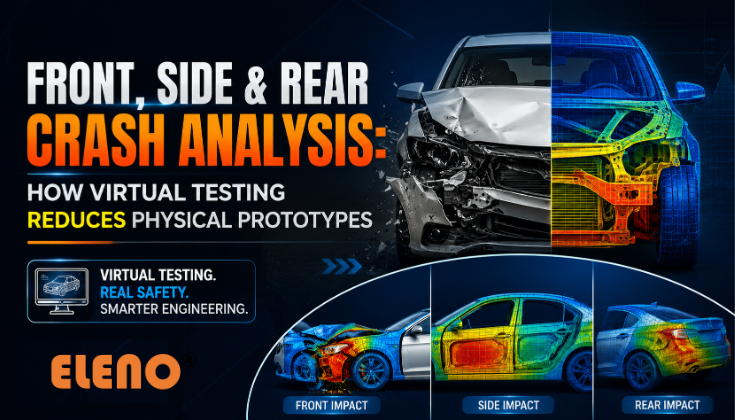
Front, Side & Rear Crash Analysis: How Virtual Testing Reduces Physical Prototypes
Modern vehicles are expected to be lighter, stronger, and safer than ever before. Achieving these goals through physical crash testing alone is expensive and time-consuming. This is why automotive manufacturers and engineering companies increasingly rely on Front, Side & Rear Crash Analysis using Computer-Aided Engineering (CAE) and LS-DYNA simulations. Virtual crash testing allows engineers to evaluate vehicle performance before building a physical prototype. By identifying design weaknesses early, manufacturers can reduce development costs, shorten design cycles, and improve passenger safety. Today, crash simulation has become an essential part of vehicle development across the automotive, electric vehicle (EV), defense, and transportation industries. What is Front, Side & Rear Crash Analysis? Crash analysis is the process of simulating vehicle collisions under different impact conditions to evaluate structural performance and occupant safety. The three most common crash scenarios include: Using advanced Finite Element Analysis (FEA) software such as LS-DYNA, engineers can predict vehicle deformation, stress distribution, energy absorption, and occupant safety long before physical testing begins. Why Virtual Crash Testing is Important Building multiple physical prototypes is one of the largest expenses in vehicle development. Virtual testing helps engineers: Instead of waiting weeks for a physical test, engineers can evaluate several design iterations through simulation within a much shorter timeframe. Modern automotive development increasingly combines simulation with physical validation to reduce development time while maintaining safety performance. Understanding Different Crash Scenarios 1. Front Crash Analysis Frontal impacts are among the most severe accidents because they involve high energy transfer. Engineers evaluate: The goal is to absorb maximum impact energy while protecting occupants inside the vehicle. 2. Side Crash Analysis Side impacts provide very little space between the occupant and the impacting object. Simulation helps engineers evaluate: Improving side-impact performance is especially important for achieving high vehicle safety ratings. 3. Rear Crash Analysis Rear collisions focus on protecting passengers from whiplash injuries and maintaining vehicle integrity. Typical evaluations include: Rear crash simulations are widely used to optimize seat structures and improve passenger safety. How LS-DYNA Performs Virtual Crash Analysis LS-DYNA is one of the world’s leading explicit dynamic simulation software packages used for crashworthiness engineering. The simulation process typically includes: CAD Model Preparation Vehicle CAD models are cleaned and prepared for analysis. Material Definition Different materials such as steel, aluminum, composites, plastics, and foam are assigned realistic mechanical properties. Meshing The geometry is converted into finite elements for numerical analysis. Boundary Conditions Engineers define: Crash Simulation The solver predicts: Result Evaluation CAE engineers compare results against safety requirements and optimize the design before manufacturing. Benefits of Virtual Crash Testing 1. Fewer Physical Prototypes One virtual model can evaluate dozens of design concepts before building a single prototype. 2. Faster Development Simulation allows engineers to identify design issues during early product development. 3. Lower Development Cost Reducing prototype manufacturing significantly lowers project costs. 4. Better Safety Multiple crash scenarios can be tested before production. 5. Lightweight Design Optimization Engineers can remove unnecessary weight while maintaining structural strength. 6. Faster Design Iterations Design changes can be tested within days instead of waiting for physical crash tests. Industries That Use Crash Analysis Virtual crash simulation is widely used in: Why Crashworthiness Matters Crashworthiness refers to a vehicle’s ability to protect occupants during an accident. A good crashworthy design should: Crashworthiness engineering combines material science, structural analysis, and explicit dynamic simulation to improve vehicle safety. Future of Virtual Crash Testing The future of crash engineering is becoming smarter through: These technologies enable engineers to evaluate more design options in less time while supporting reliable virtual testing workflows. Why Choose ELENO Energy? At ELENO Energy, we provide advanced CAE simulation services for industries that require reliable product performance and safety validation. Our expertise includes: Our engineering team helps manufacturers reduce development costs, minimize physical prototypes, and accelerate product development using simulation-driven engineering. Conclusion Virtual crash testing has transformed modern product development. Instead of depending solely on expensive physical crash tests, companies now use Front, Side & Rear Crash Analysis to validate designs quickly, improve crashworthiness, and reduce development costs. With powerful simulation tools like LS-DYNA and experienced CAE engineers, manufacturers can build safer, lighter, and more reliable products while shortening time-to-market. If your organization is looking for professional Crash Analysis, Crashworthiness Engineering, or CAE Simulation Services, ELENO Energy is ready to support your engineering challenges with industry-focused simulation expertise.
Front, Side & Rear Crash Analysis: How Virtual Testing Reduces Physical Prototypes Read More »